The Playgoer

Custom Search

Tuesday, March 14, 2006

the critics' role?

The next big newsmaking event in the Rachel Corrie story will probably be the play's London re-opening in the West End on March 28. (Unless that's a first preview with press night shortly following.) It will be interesting to see if someone like Ben Brantley makes the trip to "see what all the fuss was about." I can foresee a sorry scenario in which Brantley (or whoever) gives a big shrug at it, thus vindicating Nicola and his defenders, at which the story on these shores would probably recede forever.

On the other hand if a major US critic raves, then that might renew the question of what went wrong at NYTW?

Meanwhile, though, something might be gleaned from reading all the many (mostly thumbs up)reviews from the earlier London openings (first Royal Court Upstairs in April, '05, then "Downstairs" seven months later). The Royal Court's website actually does something unheard of for a US press office--print all the reviews, not just the good ones. Ok, not all, maybe but at least a decent range--i.e. not only a selection of "better than Cats!" quotes. Worth checking out, for those wanting to learn more about the play itself. Reading a wide range of reviews, of course, gives one that parallax effect of sensing truth somewhere between all the individual opinions. (Michael Billington's review, cited here before, is also at the RC site here.)

One sample of a strikingly balanced response is Charles Spencer's in the Daily Telegraph. In light of Jim Nicola's stated anxiety over how to handle disagreement, listen to Spencer's freakishly mature approach:

As she describes the suffering of the Palestinians, and their Ghandian resistance, she ducks the question of suicide bombers and the carnage they have wreaked on entirely innocent Israelis. At times in this performance, one longs for calmer and more informed viewpoints than can be provided by a 23-year-old who has only been in Gaza for a few weeks.

But quarrelling with Corrie's occasionally glib convictions, even as you admire her courage, lends the show dramatic tension, and forces you to try to tidy up your own muddled thinking on this vexed subject.


Spoken like a true Artistic Director. Too bad he's a critic!

Monday, March 13, 2006

Let's go back...

I had been hearing for a while that this whole story actually "broke" on an Alan Rickman fan site. Well now I have located the link. (Scroll down to "2/22/06 9:28am"), May not be new to everyone out there, but I found some things fascinating about this.

I'll sum up the main "headlines" out of this, before sharing the whole post:

1) The post is dated February 22. It describes Nicola confirming the cancellation the previous day, February 21, one full week before the story first publicly broke in the NYT.

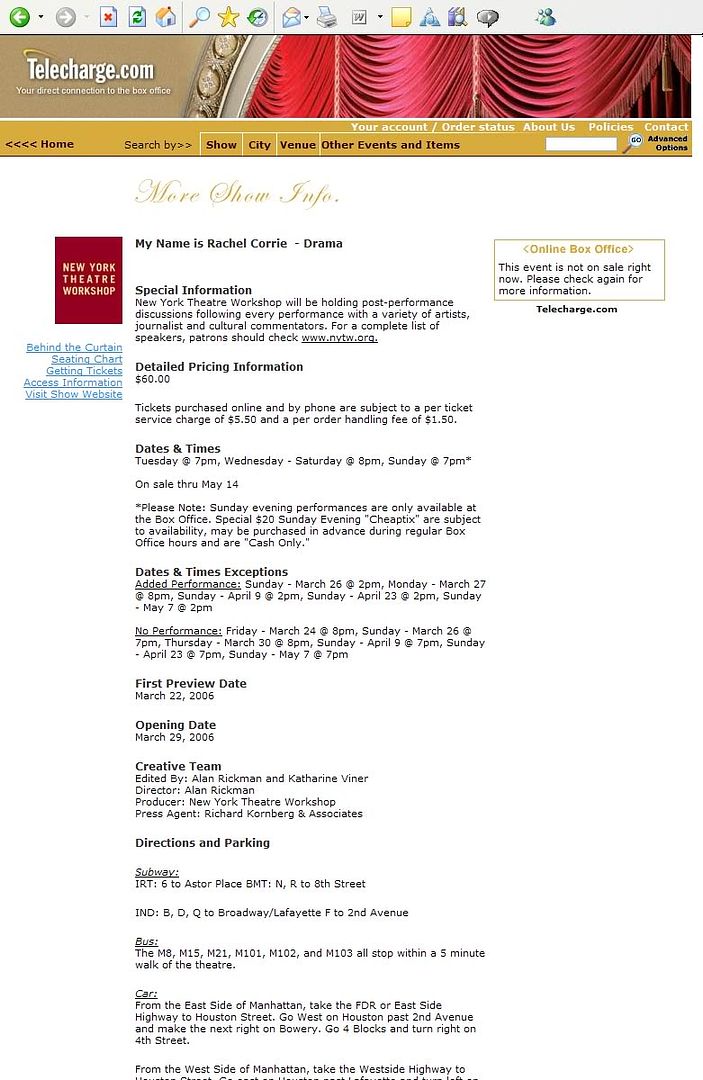
2) The poster confirms the "Telecharge" part of the story (i.e. that it was up there), and provides links to screen-cap images. This one is particularly interesting because it describes plans for post-show discussions "following every performance" and "with a variety of artists, journalist, and cultural commentators." Hm. What to make of this. Obviously Nicola was true to his word about making plans for "contextualization" but seems to have been farther along than even he admitted. Is he saying he didn't have time to book anyone? Can you believe it's that hard to get "artists, journalists, and cultural commentators" to speak in public?

3) The poster, obviously, is a big Rickman fan, and so was calling the theatre every day for info on tickets, etc. He/she does encounter at first a little vagueness from NYTW on just how "definite" all the plans are. (This is mentioned as "last week," so mid-February.) But, as you'll see, the theatre clearly implies they expect the show to go on as scheduled.

4) Then, an "awkward conversation" on February 21 where the poster is told the play has been "indefinitely postponed". That's "indefinitely." The poster then emails Jim Nicola himself, who does write back saying, ""We have postponed the production indefinitely," and , "I think it is unlikely for a NY production in the next few months." Remember this seems to have been his first public comment, even if to one individual. I leave it to you to square that with his statements since.

Ok, here's the whole post, only slightly copy edits and trimmed for relevance. (But again the raw text is here (under "2/22/06 at 09:28 am"). Keep in mind the context that this is addressed to fellow fans of Alan Rickman. Also, I'm inclined to trust the accuracy of the direct quotations, since this being written the very next morning.

...Over the past three weeks [Feb 1-21? -Playgoer] I have been in contact with the New York Theater Workshop. I had established contact with them via email, and throughout those conversations they had indicated that nothing was 'definite', but that announcement was to be forthcoming this week. I had also been calling them once per week just as a double check, and each time I called, they said nothing was 'definite', but early last week they gave a strong indication that an 'announcement' was coming late last week, or this week.
[...]
NYTW sells their tickets via Telecharge, so I was also checking the Telecharge site on a daily basis. Yesterday, I was elated to find that a full listing for MNiRC, with preview and play run dates, ticket information, as well as info on post-talk discussions with post-performance discussions after every show, (woot!) featuring a variety of artists, journalists, and cultural commentators (details were not provided). I then called New York Theater Workshop to inquire about these post-talk discussions and to discuss the best method for obtaining tickets.

To my surprise, they indicated that they had indefinitely postponed the production, and that the information should not have appeared on Telecharge. Needless to say it was an awkward conversation and the gentleman on the phone sounded somewhat flabbergasted. When I tried to press him a bit more, the phone person indicated it would probably be a year or more before the production would be reconsidered.
At that point, I emailed my contact (who is the Artistic Director), seeking a definitive answer and any explanation that could be provided. His response was, "We have
postponed the production indefinitely. We were unable to make it happen in the very tight time frame that emerged. It may be reappearing in London."
I thanked him for the info, and asked if he knew if the play was in
discussion with any other theaters in NYC, or if things were a lost cause at
this point. His response was as follows, "I really donĂ‚’t know. I think it is unlikely for a NY production in the next few months. London seems more possible."

Needless to say I was extremely disappointed, as I'm sure many of you are. Again, maybe some miracle will occur, but I am just reporting to you the information, which seems pretty credible to me at this point. Realizing the situation, in the midst of things yesterday I did screencap all of the pages from Telecharge, for posterity sake, I guess. The information was removed from Telecharge yesterday, within a few hours of my initial conversation with them. You can view them here:
http://i31.photobucket.com/albums/c364/catsplay/mnirc1.jpg
http://i31.photobucket.com/albums/c364/catsplay/mnirc2.jpg
http://i31.photobucket.com/albums/c364/catsplay/mnirc3.jpg
http://i31.photobucket.com/albums/c364/catsplay/mnirc4.jpg

[...]

The frustrating thing is that it was obviously SO CLOSE (info posted and
ready to go on Telecharge, etc). Timing (OOTP?). Political?
It's such a shame.

an alternate Corrie

As Philip Munger's comment below indicates, it turns out there are many Rachel Corrie plays and performance pieces circulating. And none of them have caused riots.

Here's an editorial from the Seattle Post-Intelligencer admitting to some small "smugness" over hosting a version by the famed Bread & Puppet Theatre.

Sunday, March 12, 2006

Semantics

Here's another Jim Nicola statement I haven't seen before, apparently from Variety, in an article printed on this Alan Rickman fan site. (Which I hear actually broke the whole story to begin with!) Anyway, some theme and variations here, but slight shift of message. I also include the interesting remarks of reporter David Benedict:

"As we went through the process, we lost confidence that, in the short time we had, we could to the best of our abilities keep Rachel Corrie's voice heard above the din of other voices attempting to use the play for their own political purposes," Nicola tells Variety. "We were never for a second concerned about the response from people who actually sat in the theater and experienced the work - the strength of the piece speaks for itself." The news that the NYTW engagement had been bumped from the schedule prompted concerns that Nicola was entering into the dangerous territory of self-censorship - fearing bigots, and silencing debate before it could happen. The move also appeared myopic in terms of the rest of his planning. Would politicized writers like NYTW regular Caryl Churchill be happy to have her work seen there again?

[...] Nicola insists, however, that the NYTW run eventually will go ahead.
"Our commitment to the project has never wavered," he says. "We asked a rather
routine question, or so we thought, of our colleagues: Could we move to a later
date and find the time for us to do our job better? That question has been
interpreted by them as censorship. It bewilders us and disappoints us."


First, there's that bit again about "voices attempting to use the play for their own political purposes." I used to think he meant something like Hamas. But now it's clear: he had a vision of Jewish groups picketing the theatre and its "terrorist" play. Does he honestly believe this will be any less of a risk six months from now? A year?

Second. One reason this argument goes nowhere is every time someone says "cancelled" NYTW responds, "No, postponed!" So let's examine this.

Let's say you are about to move into an apartment. You've met with the broker, the owner, whoever. Perhaps you've even signed the lease? So you pack your stuff, you move out of your old place. Then you get a call saying, "We actually don't want you to live here right now. But how about maybe next year sometime?" Would you consider that simply a "postponement" of your living arrangements?

Since theatre booking is essentially a real estate deal anyway, the analogy is not really a stretch. Of course, I have no idea if the equivalent of lease--contracts?--had been signed. (Should be straightforward to track down, though, no?) My point is, a postponement is a cancellation. It means, we're not doing this right now. And in the world of theatre, some hypothetical statement of maybe doing play in the future is all too familiar as, well, a rejection. Ask the playwrights out there.

Now to their credit, New York Theatre Workshop is actually notorious in the off-Broadway world for basically never committing to any show. Ask any of the "usual suspects" and they'll tell stories of "backtracking" on interest in their projects. It's an environment to nourish and encourage, which is great. But at some point all artists need to know if their work is going ahead or not. Nicola seems to enjoy juggling many balls at once, and since he calls the artistic shots there with almost total authority, he can afford to keep it loose and make up his mind--or change it--whenever he feels like it. So when most nonprofit companies mail out a brochure to past ticketbuyers announcing their "season", from NYTW you'll get something like "Here's 7 of 8 plays we're thinking of. Trust us, they're all good. And we'll probably do 4 or 5 of them."

My point is not to criticize this process. Hey, it's worked for them. But it's funny that the most charitable thing I can say about Nicola's position in all this is that he probably thought he could treat Rachel Corrie the same way--in other words, like the playwright was just another desperate downtown writer who will gladly wait another year (and let NYTW retain the rights!) since Jim is his or her only hope. You can imagine, then, how Mr Rickman and the Royal Court Theatre responded to such assumptions.

Hey, it's just a theory. And theories are still all we have...

REVIEW(s): HEDDA & NORA

Hedda Gabler
starring Cate Blanchett
Sydney Theatre Company, at BAM through March 26

Nora

adapted from A Doll House by Ingmar Bergman,
directed by Pamela Moller Kareman, Test Pilot Productions at Arclight Theatre through March 12

What Ibsen may have done for womankind has been much debated, but for women in the theatre his gifts do keep on giving. As victimized and oppressed as Hedda Gabler and Nora Helmer may be in their fictional worlds, stage divas have dominated the stage in their names ever since Ibsen's ink went dry. The dynamism of these plays' protagonists is their blessing and their curse. The roles can attract star power, bringing talent perhaps but potentially eclipsing and unbalancing the rest of each play's crucial ensemble. On the other hand, if the actress brings none of the requisite presence and depth to bear, everyone's in for a cold Norwegian night, staring at an empty fireplace.

On the New York stage, stars don't get much bigger than Cate Blanchett lately, and I will start by attesting to the Oscar-winner's natural charisma and stage chops. Which is a good start in such a massive and omnipresent role as Hedda. In Robyn Nevin's production for the visiting Sydney Theatre Company, Ms. Gabler-Tesman, as she might wish to be called today, lurks more than ever, drifting through Fiona Crombie's surprisingly (for this play) airy mansion of a set. Incessantly restless and fidgety, moving furniture pieces and disrupting flower arrangements, this Hedda would pull focus even were she not a glamour-cover movie star. At first one might be aghast at Blanchett's disregard of her fellow actors, until you realize the choice here is to make Hedda just that...well, bitchy. It's good for a few laughs up front--aided by the snappy dialogue of Andrew Upton's "adaptation" which barely refrains from outright anachronism. Blanchett's orneriness ends up working against the play, however, because it's just too winning, oddly enough--at least for the hipsters in the BAM audience perhaps new to the play. About halfway through I had to remind myself that there actually was some depth to this play, and that Hedda wasn't just a time traveler from "Sex and the City" forced into a corset to endure the Ibsenite expostulating of some 19th century stuffshirts. (Appropriately, Kristian Fredrikson's costumes inch it all up to about 1910, it seems. And not too badly.) Hedda has real emotional problems of her own. While Carrie Bradshaw might have her run away with her old flame, Ibsen makes her plan his death. What does that tell you?

So the result is actually a pretty entertaining Hedda, and that's not a phrase you hear too often. But, of course, by the time you get to that gunshot at the end (which seems more random and hackneyed than ever here) you can see the problem. Hedda's not a play about just a bored woman but a mountainous passion kept at bay by bourgeois propriety and small-mindedness. It's also about some other people, too. Anthony Weigh turns in a milquetoast, but not unlikeable George (here Jorgen), whose presence shows the protagonist's problems are not necessarily all about a bad marriage. Hugo Weaving turns in a more whiskered version of his Matrix badguy as Judge Brack--which wouldn't be too far off the mark if he didn't practically twirl that mustache so brazenly. The dead weight in the group, unfortunately, is the Lovborg of Aden Young, who generates no onstage chemistry with Blanchett (can you believe it?), thus providing no engine for the play's tragedy. If your Hedda looks like she can eat your Lovborg alive at any moment, it's time to recast.

It was hard not to think back to another Hedda just over a year ago at (yes) New York Theatre Workshop--Elizabeth Marvel's rendition in Ivo Van Hove's trippy modernization. The two productions were from entirely different schools so comparison is not really fair, and Van Hove is playing his own private game. But Marvel managed to show us in that extreme wacked-out performance the core of Hedda's diseased soul, an unforgettable portrait of neurotic, totally irrational depression. There will never be another Hedda like hers, nor should there be. But serves as a necessary reminder that Hedda is more than a girl with "attitude."
---
It's surprising that the small Test Pilot Productions company would be the first to stage Ingmar Bergman's chamber version of A Doll House (Nora), since it's been around for 25 years and already been done by many regional theatres. Other than distilling the cast down to the essential five characters (no kids, no maid) and chopping up the three acts into more focused episodic/cinematic encounters, Bergman's script may trim Ibsen's dialogue and subplots but otherwise doesn't change the original substantively at all. The main benefit, though, (aside from making for a smaller more affordable production) is the opportunity to play this still rather formal classic well-made play in an intense Bergmanesque "close-up".

Director Pamela Moller Kareman--with her design team and composer--have created a compelling atmosphere for the play. Like with the Hedda, it's nice to see Ibsen brought out of doors a bit. Here, gone is the obligatory living room (from the ultimate livingroom play!) in favor of a winter backdrop of white barren trees and scattered snow. Maybe it didn't make sense for the play, but I appreciated the freshness. And in the first few moments Kareman displayed a balletic impulse in her physicalizing of Nora's initial predicament--a gesture which lasted all of ten seconds before we were disappointingly dropped into 90 minutes of pretty routine acting-class naturalism. The lesson is: with Ibsen you cannot put more attention into the production values than the casting. Nora may be less mature than Hedda as a role (and probably as a play, too) but it demands an actress of no less magnitude and depth. Carey Macaleer, unfortunately, can never transcend her classic ingenue looks and untrained teenage-timbre voice. She may move with the grace of a dancer, but it's Nora's soul that needs to do the acrobatics here. The rest of the company is not really much better (except for the very centered Sarah Bennett as Mrs. Linde), making for some insufferably bland recitations of a very familiar text.

If there's one aspect Bergman's version is meant to bring out the most it's sex, of course. I'm sure the Sydney Theatre Company had the same idea with Ms Blanchett. Make no mistake, Ibsen can be sexy. But it was interesting to see in both cases how there's nothing more unsexy than lame acting.

Saturday, March 11, 2006

the "chorus" grows

Heavy hitters now going on the record more every day on Rachel Corrie.

Here's Harold Pinter: "'a clear case of self-censorship' amidst a political atmosphere of the 'suppression of dissent and the suppression of truth'". George Hunka has the scoop and the link to this recent interview, a must for Pinter fans.

Also, by way of Alison Croggon at her Theatre Notes, leftist mideast reporter Robert Fisk cries foul, and of course smells the traces of the Bushies in it all.

So we hear more and more "chatter" in theatre circles and also, increasingly, among the more politically minded (both pro- and anti-Israel) who never even see a play! Will we ever all join the same conversation? Or maybe that's not a good thing for people like me, who care more about the free speech challenge and artistic principles than the supposed perils of the play's preaching. But I do know that at this point it might have to take a "perfect storm" of various interested parties to keep this controversy a news story.

from Timberlake Wertenbaker

Today's New York Times prints a letter from London playwright Timberlake Wertenbaker, a former resident writer at the Royal Court and author of Our Country's Good, The Love of a Nightingale, Three Birds Alighting on a Field. She is apparently in teaching in the US at Georgetown currently.

To the Editor:

Re "Tensions Increase Over Delay of a Play" (Arts pages, March 7):
I recently taught "My Name Is Rachel Corrie" in a student seminar
at Georgetown University. It was the last play we read with the theme of war and
peace (the first was Euripides'"Hecuba").

Like all good plays, "My Name Is Rachel Corrie" shows how individuals get caught up and are often broken by historical events. My students did not take the play as an apologia for Hamas. They were moved and impressed by this young woman's passion and commitment. It made them think about courage, action and about themselves. As they read it, they felt both pity and fear for Rachel. In other words, it did what a play should do.

It is a great shame that a play that speaks so directly to young people should be tainted by political overreactions. The play does not present itself as a polemic. Its heart is the character of Rachel Corrie: this was a human being filled with courage.

The theater needs to display the same courage.

Timberlake Wertenbaker
Washington, March 7, 2006

Interesting how Rachel Corrie's much referenced sentimental appeal has made it easy to attack yet also perhaps what got it in trouble. Might someone at NYTW have been worried it would speak too "universally" to "young people"? Regardless, anyone who knows Wertenbaker's work knows she is no sentimentalist. This is as close to Caryl Churchill as we're going to hear from for a while, probably.

But wait--equal time! Alongside (or underneath) the above, NYT offers this:

To the Editor:

Since its inception, New York Theater Workshop has taken risks that few other theaters take and has provided support to artists who might very well not have found it elsewhere. It has pursued its mission with artistic integrity and intellectual honesty.

I am dispirited by the shrill chorus of voices publicly condemning New York Theater Workshop for its decision to request a postponement of the production of "My Name Is Rachel Corrie" for a relatively brief period. It is destructive of an institution that warrants the support of those truly committed to the theater — even though they may take exception to this particular decision.

Wayne S. Kabak
New York, March 8, 2006
The writer is president of New York Theater Workshop.

"Shrill"? Yet again, why can't the Times mention Playgoer by name!

Seriously, if Mr. Kabak (the "president" of NYTW's Board, listed just under Chair) thinks such an adamant rehash will help their cause--on this, day 12 of the story--they are headed for even more grief over this than they could imagine. (Sounds like Bush's first response to the Dubai Port deal, no?) It's become so clear from the past week and a half that NYTW now has now lost some of that "support" from its years of "risk" taking by trying to avoiding risk altogether, and then endlessly obsfuscating about that decision. To tell politically committed theatre lovers and progressives to now just shut up, effectively, and close our eyes and remember the good times, well...

Addendum: As much as Playgoer would like to take credit for being the chief voice of "shrillness" here, I do wonder who else Kabak might be referring to as this "public chorus" of dissent. Once you take into account this is a specific letter responding to a specific NYT article (3/7), then make no mistake: he's aiming at our friend and NYTW "Usual Suspect" Christopher Shinn, so prominently quoted in that article. Theatre artists are indeed taking chances in speaking out. But if they don't do so, they implicitly accept working in a cowered and timid theatre scene.

Friday, March 10, 2006

For the Record

"What Jim said was that he had postponed this play because Hamas was elected and Ariel Sharon was sick and it was a bad time to do it. I think that’s a mistaken reason to postpone the play. I am sorry he did that. I think it was wrong. I hope he reverses himself. I hope the play is done at the New York Theatre Workshop . That would be the best thing for the New York theatre community and for all of us.

"It is also to me very important to say that Jim Nicola has been an Artistic Director of real principle for twenty years. The New York Theatre Workshop has been an invaluable member of the American theatre comminity and has done magnificent service. And I think this is a delicate moment where it’s actually important that we all attempt to appeal to the better angels of our nature. It's not just a question about being against censorship--which we are—and again I think Jim made a mistake. I don’t think those were the right reasons to not do this play. But I think the best thing is if the Workshop and Jim change their minds and that’s what I think we should all work towards, because I think he’s a very very valuable member of the progressive community."

-Oskar Eustis, Artistic Director of the Public Theatre, at the New School's Thursday evening panel discussion on political theatre.

Now that I've seen the online archived footage for myself, I just wanted to get the quote exactly right that others have already alluded to. Upon hearing it, it was clear to me this is indeed a must-quote statement--for no other reason than it marks the only statement by a prominent New York theatre artist on this issue, other than playwright Christopher Shinn. I can respect Eustis's respect of Nicola and NYTW's legacy. But he leaves no doubt about the "mistake" of this call, and you can just hear him trying to communicate through third parties.

I can only echo what my friends here have said about this video: it is essential viewing if you're interested in this controversy. (Really just from 1:32:23 to the end, 1:43:12. Yes, the last 10 minutes.) Watch as three playwrights, a cautious Artistic Director, and a bemused moderator all squirm over what is introduced (by off-screen oldschool badboy playwright Robert Glaudini, god bless him) as "the elephant in the room." Watch the body language when the question is finally asked. It's so palpable that none of them want to talk about this. WHY?

And do stay tuned till the final cut-off, when the off screen voices of "the people" can be heard:

"We got this close."
"Yeah."
"The last question!"

(Or perhaps not?)

Ten Days Later: Why this Matters

Ten days ago, the New York Times published a small article announcing that New York Theatre Workshop had "postponed" a production of a British documentary play about the life of an anti-Israeli protestor. The official story has remained relatively unchanged since then, and almost nothing significant has happened yet in the theatre world as a direct consequence. (Except for a sure to be successful London West End opening for said play.)

So why are we still talking about it? Or, more precisely, why are more and more people talking about it, after relative silence in both the theatre press and theatre community at first?

For starters this is obviously a "free speech" issue. Yes, NYTW is a private organization. No, no one is "banning" the play anywhere else. But whenever a work of art is withdrawn (by whoever) from the public for reasons of political content, we are right to step up and ask questions. Especially if the work is not available for viewing elsewhere. But even so--imagine, if Barnes & Noble or Amazon.com removed from its stock a well-credentialed book arguing the Palestinian side of that debate, would they be questioned? Hell, yeah!

But, look, I'm a free speech absolutist, and not everyone is. Some say, hey it's Jim Nicola's theatre so let him put on what he wants. Fair point. To which I answer--it seems up until four weeks ago, this was the show he wanted to put on. And one reason we are still talking about this is that there has been no clear resolving explanation about what changed his mind. To all who suggest this play may not be worth defending--either because of its politics or its apparent sentimentalism ("Anne Frank for the intifada," as one friend imagines)--I say, that may be your call, but it sure wasn't Jim Nicola's. I would think all theatre artists would be worried about a scenario where an Artistic Director backtracks and effectively abandons a project he or she previously supported. Especially when politics are involved.

Which brings me to a potentially even bigger significance. Or two.
1) Is this what we have to look forward to in the post-9/11 New York Theatre? Obviously, now, certain political issues have become more sensitive. I will leave aside for the moment about whether the New York theatre is too uniformly or reflexively anti-Palestinian or anti-Arab. But I have a hunch the play might not have had such trouble 5 years ago. What else could Nicola have been referring to with his vague references to parties who might exploit the play for their own purposes, who "would be using this as an opportunity to position their arguments." If you're not with us you're with the terrorists?

2) Ok, forget about global politics and let's selfishly focus on the little world of serious professional (non-Broadway) theatre. Is this the kind of leadership we can look forward to in the age of not only political intimidation, but corporatization and fundraising super-dependence? Some who know Nicola are describing his behavior along the lines of "sad" lately--and I take that to reflect a certain lack of control he feels over the events, a smart guy who knows better but feels like his hands are tied. What I'm "sad" about is how this episode throws into relief how we can no longer expect our artistic leaders--even of our "nonprofit" institutions--to lead and stand up for what they believe in.

Last Night's (non-)Panel

So I was not able to see the "The Public Theater Goes to War" panel last night, either in person or online. But from the reports I hear, seems like they're not going to war against much. George Hunka caught the webcast and has written it up.

In short--no one seemed very interested in taking on New York Theatre Workshop or defending Rachel Corrie the play (or the person for that matter) until the last 5 minutes of a two-hour event. In fact, the defense of "haven't read it, no comment" was invoked a little too easily, it appears. Are you guys for free speech or aren't you? And if you think Nicola's actions are ok if the play is a bad play--then aren't you curious why he picked it in the first place? And aren't you--as playwrights--concerned about an Artistic Director out there accepting plays for production and then changing his mind about whether they're good or not? (And for the record, the "bad play" excuse is not even one of the many rationales Nicolas has offered.)

BUT--the only news to possibly come out of this is that Public chief Oskar Eustis actually appears to have flat-out said Nicola's decision in this case was wrong(!) even though he praised him personally and his record at NYTW. So that's something. Maybe. Then again, I'm already hearing conflicting reports of how definitive this statement was and--again--it was held back until the very last minutes.

A reader has emailed me his blow-by-blow account, which I'll share in full since it gives some great details and is the closest we'll have to a transcript until one is issued or if the webcast is archived. (In which case, remember to fast forward just to the last 5 minutes!)

I missed the very beginning, but basically what happened is that they spent an hour and half talking about everything BUT Rachel Corrie. Andthen they did 20 minutes of questions and no on asked anything aboutit. And then the moderator said we have time for two last questions, and then one, and then STILL no one had asked about it.Then he calls another couple questions, and a woman asks something like, "Given the recent news about New York Theatre Workshop, could you talk about the risks beyond funding of doing political theatre." Andthen people in the audience start applauding.And then Brett Leonard asks if they're applauding because they WANTRachel Corrie cancelled or want it uncancelled. (They wanted it uncancelled.) And then there was like a 2 minute shoutingback-and-forth between the audience and the panel.

THEN one of the panelists (forget which) says that the panelists all talked before the panel started--except Eustis, who hadn't yetarrived--and decided that they wouldn't talk about Rachel Corriebecause none of them had read it. At that point, Eustis says that he*has* read it.During that back-and-forth with the audience, Leonard, Hagedorn andRabe all say that they don't know enough about the particulars to comment. But Leonard comes pretty close to defending it, saying that it's not censorship, it's just an AD changing his mind. He says that someone sent him a petition to sign but he doesn't know what he would be signing up for because he doesn't really know the details. And thatMTC cancelled CORPUS CHRISTI and Papp cancelled something. (At whichpoint Eustis chimes in, "Yeah, not the finest hour for either institution.") So, implicitly, Leonard's point seems to be, what's the big deal. But then he DID go on to say that if it was cancelled for tricly political reasons, he doesn't agree with that. (Thanks.)Finally, Eustis says the obvious: that Nicola made a mistake, that the best thing that could happen is for NYTW to change its mind, and that we all need to appeal to their "better angels" here because Nicola has been an outstanding AD and a politically adventurous AD and a real asset to the NY theatre scene.

Then--at that instant--the moderator said goodnight and the feed went dead. Mind you, everything that I just described happened in the last 4 to 6minutes of a panel that lasted like 100 minutes. So it was utter banality for like 95 minutes followed by 5 minutes that were pretty chaotic and strange. In the middle of the chaos, Eustis asked why none of the people with Corrie questions went up to the microphone to ask them during the Q and A. Not sure why they didn't--maybe they all figured that *someone* would surely ask those questions.

It was also sort of sickening for people like Rabe and Leonard to sit up there for like 90 minutes and blabbing on about the importance of political theatre and theatre that's willing to take chances and engage in the Serious issues and complaining that there isn't enough of that out there and then--when there is actually something on the line--to say "It's complicated" and "I don't know the facts" and "I haven't read the play." Anyway, it was bizarre.

Ask Telecharge

Gee, looks like Rachel Corrie can't be cancelled since tickets are still for sale on Telecharge!

Thanks much to Philip M. for hunting down and posting the link in Comments.

UPDATE: Oops. No more. Sometime between my posting this and 3:30 today, it just disappeared. Funny.

Thursday, March 09, 2006

Political Theatre Panel tonight!

Playwrights David Rabe, Jessica Hagedorn, and Brett C. Leonard will appear tonight at an already announced panel discussion sponsored by the Public Theatre called "The Public Goes to War": "Writers, directors, designers and performers who have been part of productions that address war and its discontents, talk about the spirit of their times and how theater can effect change. " While initially the implicit focus may have been Iraq and promoting the Public upcoming opening of Stuff Happens...word has it tonight people will be showing up expecting to talk about "Rachel Corrie" and New York Theatre Workshop. So if you're downtown tonight, try to get in!

Oh, and by the way: it is co-sponsored by "The New York Times Community Affairs Department"

Tickets are $10. Free if you're a New School student or alum. It's at The New School, Tishman Auditorium - 66 West 12th Street (off 5th Avenue).

Or--watch the live webcast for free here.

Antecedents II

Many thanks to the reader who either has a good memory or very quickly did the search on Genet's Prisoner of Love and guess where it was done! (scroll down to "1994-95 Season"). So there's a new question for Mr. Nicola.

But maybe Jim doesn't remember it too well since he was also busy that season with this.

Antecedents

The veteran theatre critic/reporter Jeremy Gerard has done an excellent piece for Bloomberg on the Corrie controversy. Of the most service is reminding us of yet another precedent of the radioactivity of the Palestinian cause on New York stages--in this case at the House of Papp:

In the summer of 1989, [The Public's Joseph] Papp abruptly canceled an appearance by a touring Palestinian theater troupe. El-Hakawati (``The Storytellers'') was slated to perform ``The Story of Kufur Shamma,'' the tale of a Palestinian refugee's return to his long-deserted village 40 years after the birth of the modern state of Israel.

As with ``Rachel Corrie,'' protests erupted. Somewhat more transparent than Nicola, Papp simply announced that he'd had second thoughts. Since he had never presented a pro-Israeli play, he told the press, ``it just seemed inappropriate'' to produce ``Kufur Shamma'' as his first statement on such a hand grenade of an issue. Thinking he could buy time as well as support, he promised to present the play within a year. In fact, Papp, already dying from cancer, never did produce ``Kufur Shamma.''

I have already mentioned Joanne Akalaitis's problems in staging Genet's Palestinian piece, but I forget whether that was when she was running the Public. (I also forget the name of the play. Or perhaps it was an adaptation?)

Gerard also rightly interrogates this vague term "contextualization" Nicola keeps calling for. He taces its cachet to PBS, sure enough, and reminds of the many CYA "panels" they'll do (like the recent Armenian Genocide program) to avoid any impression of a stand on an issue--and avoid funding cuts.
Whether we are smart enough to know the difference between life and art --between the facts of the Civil War and ``Gone With the Wind''; between the Anne Frank of her diary and the Anne Frank of the diary that Otto Frank published after the war; between J.F.K. and ``JFK'' -- art has no responsibility to literal truth.
Of course, such an argument is safe only in an intellectually vigorous and well-informed society, in which ``contextualization'' is a natural consequence of education, and in which a hundred counterarguments will sprout up around an unsound idea. When, instead, popular culture substitutes for history, all art is dangerous because its relationship to truth has shifted. It has become propaganda. But that's not, in the end, art's fault.
Amen. I'm sorry, but if the audience is too lazy to go out and learn something on their own about the Gaza strip, if they rely only on a 90-minute one-woman show on East 4th Street... then God, Jehova, or Allah help us all in this democracy of ours.

Wednesday, March 08, 2006

Where's Tony?

We have asked this on the site before: Where's Tony Kushner on this story?

Our assumption is he feels too conflicted, too loyal to New York Theatre Workshop and to James Nicola personally (for producing not only Homebody/Kabul, but Slavs, and probably early career support). Our assumption is also that he would oppose canceling a play merely because it might give voice to the Palestinian cause and offend conservative Jews. I mean, this the guy Steven Spielberg went to to make Munich palatable. And he has pissed off his fellow Jews plenty of times himself. AND, most of all...we all know he loves a good political fight.

The Oscars are over now Tony. Hope you had a good trip home and sorry you lost. But we need you on the record on this. I've heard vague rumors of him talking to Nicola in private. But if he's counseling reconciliation, Jim doesn't seem to be hearing him so far.

At some point we'll just have to assume he supports NYTW's action. Or, perhaps worse, is suddenly indifferent to free speech in the theatre. And to open discussion of the Middle East(!).

Unless--and here's my optimistic scenario--unless he all along has been secretly negotiating through back-channels some magic deal that will make everything ok! Not impossible. Think: if anyone had the cred and expertise on all the major issues here (downtown NY theatre, the London stage, politics & the arts, Jews & Arabs) it would be he.

So we're waiting, Tony. Save the day. And save your favorite theatre company.

NY Observer's Must-Read

I swore I would try to get back to reviewing today. So many shows! Lieutenant, Hedda, and, yes I'm getting to Abigail's Party and The Seven. Before they close!

But I must stay in Corrie-land some more now that, finally, someone, with a louder meagaphone than a blog, is asking the right questions. I'm speaking of John Heilpern, theatre critic at the New York Observer, a paper doing some damned fine investigative journalism and cultural criticism lately.

Where to begin. In short this is a must-read and might make some news today, since Heilpern's interview with Jim Nicola gets him on the record in a focused way no one else has so far. To take bits out of context would spoil the satisfaction in reading the whole thing. But just so you get the idea...

Heilpern begins with the kind of befuddlement many will find familiar:

We’ve heard about unnamed Zionist pressure groups and anonymous theater donorswho object to the telling of a humane story about a utopian 23-year-old American girl who was killed by an Israeli bulldozer in the Gaza Strip as she protested the destruction of a Palestinian’s home. We’ve heard the theater’s cornered artistic director, James Nicola, talk darkly about realizing suddenly that there existed “a very edgy situation” that had taken root in the city “after Ariel Sharon’s illness and the election of Hamas.” We’ve heard it all—including the whirring sound of the New York Theatre Workshop backpedaling all it can to
rationalize its weird decisions.

But when I asked Mr. Nicola, as well as the president of the board of trustees and the New York Theatre Workshop’s managing director, exactly who—and how many—have been protesting about the play, no one could tell me.

So what does he do? Gets Nicola on the phone. From Italy. And he asks him a few simple--yet previously unasked--questions:
“How many members of the Jewish community in New York have made their feelings known to you opposing the play?”

“I haven’t personally spoken to any members of the Jewish community who’ve opposed the play,” he replied. “I have spoken to many Jewish friends who have had degrees of discomfort with the topic.”

Wha wha wha? This is what this has all been about? "Degrees of discomfort" and not "opposing the play"? How powerful do you have to be for your "discomfort" to outweigh so many others' certain "opposition" to the cancellation?

More questions:
“When you said in The Times that it was a ‘fantasy’ to present the piece as a work of art ‘without appearing to take a position’—what is the position that would prevent you from doing what you do?”

" … when I first read this play, it affected me deeply,” he said. “I thought it presented an opportunity to share with our community a powerful message that the good fortune to be born into comfortable circumstances comes with theresponsibility of conscience. One must always be aware of the misery of others and take compassionate action.”

He went on to explain that “there was much unsubstantiated speculation from different quarters on the circumstances of Rachel’s time in Gaza. It became apparent that by presenting the play on the current schedule this speculation might become the event itself instead of the play …. ”

I read this as: "Someone finally told me who Rachel Corrie was." While I personally never heard of Rachel before last week, it seems she has been real anathema to the pro-Israeli right (or self identified liberals who sway right just on Israel) for a long time. Again, the "true story" has caught up with events.

And, finally a question you won't (ok, haven't) read in NYT:
“What do you think your decision is saying to the Arab community?” I asked Mr. Nicola.

He replied, “We haven’t heard from anyone in that community, and I can’t speculate as to their reactions.”

Woah.

If nothing else this exposure might inspire Arab Americans to start letting him hear from them. That is, if they're not afraid of deportation in Patriot Act America. Heilpern has no problem getting a comment, though:
“Maybe they’re waiting for peace in the Middle East,” said Maha Chehaoui of the Nibras Theater, a small Arab-American theater company in New York.

Exactly.

Again, a must-read for all who care about this topic. And for all who like to see some rigorous opinion journalism in the print media.

Tuesday, March 07, 2006

Not Bitter...

...but I do find it interesting that only a couple of Sundays ago (2/26/06) New York Times Arts & Leisure had no problem citing a theatre website by name and yet today could not. The only difference was, the reference was to a chatroom, not a blog, and the subject was Les Miz:

Certainly when it comes to quick comebacks, the choice of show matters. ''Les Miz,'' with its grand themes, inspired grand passions among fans happy to see the show more than once. For some theatergoers, then, the comfort of nostalgia may indeed outweigh the thrill of the new.On All That Chat, the message board at talkinbroadway.com, Marco49 was happy to hear about ''Les Miz'': ''It never shouldhave left,'' he wrote, ''and I hope they extend its six-month return!'' Bandboy, on the other hand, felt that it was ''sad that it has come to this.''

What does this tell us? Something bigger I hope than Playgoer's sour grapes. The logic (if I may attribute the decision to logic) would appear to be that the web is a legitimate source of gossip and "man on the street" populism...but not for more serious discourse or reporting. But someone please explain how, from a journalistic view, "Marco49's" gushing over Les Miz is categorically distinguishable from Christopher Shinn posting a--shall we say more thoughtful?--bit of commentary on Playgoer?

Except that one helps the theatre biz and one doesn't. But let's not go there.

I promise that's the end of Playgoer's blogosphere-martyr complex.

Addendum: Duh! Someone just pointed out to me this sentence in Tuesday's NYT article right before the "Playgoer paragraph":
In a letter posted on the political Web site Counterpunch.org, for example,
the actress Vanessa Redgrave, a longtime supporter of the Palestinian cause, called the workshop's decision "censorship of the worst kind" and the "blacklisting of a dead girl and her diaries."
So I guess "Counterpunch" counts, too. (Ok, now that's the end.)

Royal Court Statement

(UPDATE: I have confirmed the authenticity of this text with another copy independently obtained.)

"Olyblog", a blogger from Olympia, WA--i.e. Rachel Corrie territory--has gotten hold of and posted the official statement from the Royal Court (yes, it's a press release, I guess, but it hasn't been widely disseminated in full).

Here is the complete text. It's long. But thorough. Score one more point for credibility on the other side of the Atlantic:

We have been surprised to read recent assertions made by James Nicola, Artistic Director of the New York Theatre Workshop, surrounding the run of MY NAME IS RACHEL CORRIE which had been scheduled to play there in March, April and May 2006. There are many factual inaccuracies which we would like to address.

Plans for the production of MY NAME IS RACHEL CORRIE were definite. Representatives of the Royal Court Theatre met with NYTW in New York to finalise arrangements seven days before learning that Mr. Nicola wished to postpone the run indefinitely. The production schedule had already been laid out by the NYTW on January 31st,with the first preview scheduled for March 22nd and closing night for May 14th; a budget had been set; a press release had been mutually agreed; flights had been booked and paid for, all with the knowledge of the New York Theatre Workshop. Furthermore, ticket information was already listed on the site of the U.S. ticketing agency Telecharge on February 23rd, 2006 with the correct information about dates, times, original creative team and casting.

Asking for a postponement at this stage in the planning can hardly be described as "a rather routine question, so we thought, of our colleagues" as Mr. Nicola says in his statement on the NYTW website.

In the same statement, and in a letter to the L.A. Times of March 5, 2006, Mr. Nicola claims that "With a schedule largely driven by Alan Rickman's pre-existing film commitments, we had less than two months to consider mounting the production." In fact, Alan Rickman first visited the New York Theatre Workshop to discuss the possibility of staging MY NAME IS RACHEL CORRIE in November 2005. The dates of the production were determined by availability at the theatre, and Mr. Rickman's film schedule was to be ordered around this. He held back from making any film commitments until after the dates were offered and confirmed by NYTW.

In the New York Times on February 28th, 2006, in an article titled, 'Play about Demonstrator's Death is Delayed', it is reported that Mr. Nicola decided to postpone the work "after polling local Jewish religious and community leaders as to their feeling about the work." This much he had explained to Diane Borger, General Manager of the Royal Court, during a phone conversation on February 17th, in which he asked to "postpone indefinitely" the production. In a later conversation, he said he would be willing to reassess the political climate in a year's time and decide then if he could produce the piece with a companion work that would offer an alternative perspective. As explained to Mr. Nicola, this was not acceptable to the Royal Court, as he gave no commitment at this time to revised dates for the production at NYTW. The Royal Court and the Corrie family have always believed that the play speaks for itself. In the words of Rachel's father, Craig Corrie, "No one should have to take a poll to do this play; it is a work of art."

A postponement at any time, but especially at this late stage, is not the action of an organisation committed to producing MY NAME IS RACHEL CORRIE. The Royal Court cannot be confident that the political climate will have changed in a year's time and we are deeply saddened that the New York Theatre Workshop feels unable to let the play be seen now. However, the Royal Court Theatre remains committed to bringing MY NAME IS RACHEL CORRIE to a U.S. audience at the earliest opportunity.

Again I think the timeline is crucial. One would think these facts would be pretty easy to establish and why would anyone lie about them if they can be checked? Obviously NYTW has downplayed the finality of the decision. I'm sorry, but tickets available on Telecharge? Sounds pretty set to me.

Once such a firm commitment is established then the NYTW (namely Jim Nicola) has to explain the process by which is mind changed so extremely. He can no longer say I was kinda thinking about it and then kinda thought again. Everyone is going to be asking one simple question: what happened to make you go from "put it on Telecharge" to "hold on"? Who exactly did you "poll" to get a second opinion? At least with Corpus Christi and the Brooklyn Museum incidents, we had a "Catholic League" and a Rudy Guilliani raising the ruckus out in the open. Now the opponents hide in the shadows.

Will the real opponents of "Rachel Corrie" please stand?

Dramatists Guild steps up

Also published in NYT today, a letter (dated March 2) from Dramatists Guild prez and playwright, John Weidman. He apparently wrote it last week, back when the story first broke in McKinley's February 28 article :

To the Editor:
Re "Play About Demonstrator's Death Is Delayed" (Arts pages, Feb. 28):
Jim Nicola, artistic director of the heretofore admirable New York Theater Workshop, flounders around attempting to defend his decision to postpone "My Name Is Rachel Corrie," a provocative new play about Israeli-Palestinian relations, three weeks before its first performance.
Surely the theater is precisely the place where such controversial subjects should be aired and debated. And surely playwrights courageous enough to tackle such controversial material deserve a theater courageous enough not to postpone their play when it proves to be precisely as controversial as they must have known it would be when they accepted it.
John Weidman
New York, March 2, 2006
The writer is president of the Dramatists Guild of America.

So good for the Dramatists Guild for calling this right from the get-go. Too bad no one knew.

I've wondered whether part of the delayed reaction (which I'm glad to call now only "delayed") from prominent playwrights had anything to do with My Name is Rachel Corrie being not only a foreign work a "documentary play"--in other words, no "playwright," per se. I didn't suspect a conscious snub, but perhaps a lack of identification. But statements like that of Christopher Shinn and Weidman here make clear, I hope, the need for solidarity. A play's a play.

Monday, March 06, 2006

Heads Up

After the Tuesday Times piece circulates, NYTW will probably go on the offensive, accusing the Royal Court of not returning their calls(!) and cutting off all negotiations. Or so I gather from my sources, at least.

We'll see what Royal Court says to that. But one has to say--even if that's true, can you blame the Court? Jim Nicola pulled the plug, proved he had only a wimpy commitment to the piece, couldn't guarantee another opening date... And on the other hand you have a West End producer ready to go. What would you do?

So now, on top of everything else, NYTW finds itself in an International Theatre Incident. PR-wise, I say it's a no-win.

Now it's a story

As posted on NYT.com Monday night, Jesse McKinley has now published a followup to his breaking of the "Rachel Corrie" story exactly a week ago. The piece makes clear the story is not over, and new news is not good news for Jim Nicola and NYTW at this point.

"Nut graphs":

And in a sign of heightened tensions between the two theaters, the Royal Court
also issued a statement to address "factual inaccuracies" in a letter posted on
the workshop's Web site and assertions made by James C. Nicola, the workshop's
artistic director.
In particular, the Royal Court's statement took issue with the workshop's assertion that the planned production of "Rachel Corrie" was not definite, saying that press releases had been finalized, previews set, budgets approved, flights booked and tickets listed for sale. "I don't want this to become a spat between two theaters," said [Royal Court spokesman Ewan] Thomson, who faxed a copy of the statement to The New York Times. "But there were certain factual inaccuracies we wanted to address."

On the surface, these questions of plane tickets and press releases may seem petty and immaterial, especially to the outside observer. But the squabble over them does seem to hint at larger discrepancies behind the scenes. Simply put, the Royal Court is bristling at NYTW's attempts to effectively disown the show. Nicola's way of denying a "wavering commitment" has been to say...there never was a firm commitment in the first place! No schedule, no announcement, blah blah blah. That's where the Royal Court is now poking holes.

Nicola is out of town these days, according to the piece. Managing director Lynn Moffat stands by the "postponed, not canceld mantra," wondering why we all still don't get it. Royal Court offers an appropriately dry riposte:
"A postponement at any time, but especially at this late stage, is not the action of an organization committed to producing 'My Name Is Rachel Corrie,' " the [Royal Court] statement read, adding that there was no assurance that the political climate in the Middle East would change anytime soon.

Exactly.

Oh, and by the way, check this out:
In New York, the playwright Christopher Shinn — a member of the workshop's extended artistic ensemble, the Usual Suspects — also published a short essay online calling for more playwrights to come forward to protest the workshop's decision."If I were a young playwright, I would get the message loud and clear: don't write political plays if you want to get them produced," Mr. Shinn wrote.
(emphasis mine)

Playgoer readers may of course recognize this mysterious "online essay" as familiar.

Thanks, NYT.

(You think they're gonna give you a medal, Playgoer, after love letters like this?--ed.)

Petition

Thanks to Jason Grote for starting this petition letter to James Nicola and New York Theatre Workshop. 180 signatures and counting, including playwrights Eve Ensler, Brooke Berman, and Stephen Adly Guirgis.

You can read it and add your own name here.

reader forum

I heartily recommend the spirited reader comments here.

Please encourage any theatre people you know with any association with New York Theatre Workshop to check out our conversation here and hopefully post. For anyone wishing an even more anonymous and private outlet for their rants--or better yet inside tips!--email me here.

NYT breaks silence

Ok, just one columnist. Resident Arts-egghead Edward Rothstein--a cultural conservative but pretty erudite critic-at-large--essays a response to the "Rachel Corrie" controversy. And it's a frustrating read because he just refuses to be pinned down. In short, he acknowledges the bungling of it all by New York Theatre Workshop. But, he can't help but end up making Jim Nicola's argument for him (and making it more cogently, I might add) by slamming the play itself as muddled and blinkered propaganda. Rothstein clearly has no truck with the anti-Israeli cause and pretty much says Rickman and Viner are super-selective in their script to make the Palestinians come off better and Rachel more naive and less militant than she was.

Basically, his argument is that it was a bad play to choose....but NYTW looked stupid cancelling it.

How could this happen? How could a theater take on a play like "Corrie" and not know what it was getting into? How could it then postpone the production and not know that the outrage of its colleagues-at-arms would be as fervent as the imagined reaction of patrons and protestors?

But taking any quotes from this serpentine argument out of context is problematic. Don't confuse the above with any denunciation of censorship. Rothstein invokes the "free speech" mantra with not a little distance--saying NYTW brought the accusation upon themselves, but he's not jumping on the bandwagon.

At least Rothstein admits/confirms this is a controversy. And apparently a louder one (within NYTW) than has been reported so far....Also, he seems to have read the play, at least. (Hmm, who gave him a copy?) So what we're getting here is some kind of informed criticism for a change, and a more detailed summation of the play's supposed problems than Nicola has yet done.

Rothstein clearly has sources here inside the theatre. Hence this slightly news-breaking clarification of Nicola's repeated call for "contextualization": "The company discussed staging other plays about the conflict alongside this one; attempts were made to arrange post-performance discussions, too. But that required time." You know how much time it takes to organize a post-show talkback? 1) Get microphone. 2) You're done.

Ultimately what we see here is reducing the fight to the poltical issue itself. If the real-life Rachel Corrie was wrong, then the play is not worth defending. Let's say all of Rothstein's critiques are valid. We've certainly had many equally lame, simplistic, reductionist, one-sided plays in New York about different political issues. (The Exonerated, anyone?) So I'm bothered by the exceptionalism floating around the debate over this play. "Not this issue"-- we keep hearing--"Don't give a biased distorted view of this one. We can't handle that."

Let's leave aside for a sec, Michael Billington's apt reminder that art needn't "tell all sides" at all. Let's leave aside the long tradition of making heros and martyrs in our art out of all kinds of problematic political rebels--which we have survived fine, by the way. If we decide that "Rachel Corrie" is a deeply flawed and misleading piece that would be unnecessarily incendiary...then why did Jim Nicola pick it??? I keep coming back to this in my head. If Nicola cannot dance with the one he brung (to twist a phrase), if he cannot--for better or worse--defend his play selection by giving it a hearing...then he has no business being in a position of artistic leadership.

Sunday, March 05, 2006

Palestinian Sympathizer/Gay Jesus: Fair Comparison?

There are of course many important incidental differences between My Name is Rachel Corrie and Corpus Christi that should give us pause before making easy comparisons. But I'm not referring to the perceived level of offensiveness or political issues involved. More consequential, it seems to me, is the absence in the present case of a name playwright like Terrence McNally for artists to rally around. Who becomes the free speech martyr here? Alan Rickman? The already dead-Corrie, who didn't have friends in the theatre community anyway?

Sadly for Jim Nicola another difference emerging may simply be--not as many people care about New York Theatre Workshop! Manhattan Theatre Club may not be MGM, but probably deemed more picket-worthy.

The main difference in how to the two cases have played out is clearly in the coverage. And to illustrate that an intrepid reader has assembled a compelling chronology of how the Corpus Christi story played out in the press in just one week and led to real results. Take a look:

Thursday, 5/21/98: MTC quietly announce cancellation of CORPUS CHRISTI through its press rep.
Saturday, 5/23/98: NYT picks up the story of the cancellation. A short piece in Arts & Ideas.
Wednesday, 5/27/98: A 1200 word piece in the Arts. Athol Fugard says he is withdrawing his play from the following season. From the article:<>
Thursday, 5/28/98: NYT runs an editorial titled "Censoring Terrence McNally." It says, among other things, "It is easy to appreciate the dilemma Lynne Meadow, the Manhattan Theater Club's artistic director, found herself in, but it is impossible to approve her decision."
Also Thursday, 5/28/98: An Arts section article on the possibility that the play would be staged elsewhere. From the article:<>
Friday, 5/29/98: A front page story about the theater's decision to mount the production after all.

So far the NYT has run two pieces on the Rachel Corrie story: the first, to be fair, broke the news to us all and got this started. But the more I look at it I have to say the reporting is generous to NYTW and is pretty much the story as Nicola would want it to be told. You tell me. And then the lame, inconsequential Arts Briefly notice on the West End transfer, which effectively says game over.

In other words: I firmly believe that anyone relying on the New York Times for their theatre coverage (and may we assume that's not a small number of folks) could easily have no idea at this point there is a free speech debate going on in the off-Broadway nonprofit theatre. Even the LA Times readers have been better informed.

latest Nicola statement

Once again, the LA Times (not NYT) has oddly become the MSM forum for this controversy, despite being 3,000 miles away from the action.

Jim Nicola rehashes some familiar points and phrases in a letter to the editor responding to "Rachel" co-creator Katherine Viner's op-ed there Wednesday laying out her case of censorship. The only news here is his reference to a proposed national tour of the play he claims he was ready to sponsor. Huh?

I am bewildered by Katharine Viner's "A message crushed again" (Opinion, March 1). New York Theatre Workshop has never shied away from controversial work. We moved toward a production of "My Name is Rachel Corrie" with short notice and almost no preparation time, the schedule largely driven by director Alan Rickman's film schedule. We were also in discussions with the Royal Court about helping mount an American tour following the New York engagement. When we discovered how deeply ingrained the attitudes were on all sides and what a marketing and contextualizing challenge this posed, we became convinced we didn't have enough time to best serve the powerful voice of Rachel Corrie. We asked our London colleagues about altering the time frame. We did not cancel the production but proposed doing the play next season when all parties might be available following the proposed American tour.Our commitment to the play has never wavered. On the bright side, I am pleased to see that a West End engagement has been secured. But to have our request for more time blown into a screed about censorship is stunning.
JAMES C. NICOLA

Well, let's hear more about this "tour." When he speaks of a postponed production "next season" happening "following" such a tour, then.... why was the tour not still an option?

"Pleased" about the West End production? You bet! Way to take the pressure off. More than compensates for any "fuck you" message implied from the Brits.

And, lastly, what do we make of the fact that today, on day 6 of the story, Nicola keeps pleading for "more time" and yet has still not given one example of more time for what. This claim only gets more specious every day.

Saturday, March 04, 2006

Nicola on the record

Seems like there was once a off-broadway leader who was a real free-speech political-theatre champion, and his name was James Nicola. Many thanks to the reader(s) doing their research and posting some now-embarassingly hypocritical quotes here.

Particularly damning/sad:

At NYTW, we always try to put forward strong, provocative thoughts. We never expect audiences to embrace ideas wholesal—-we're not indoctrinating them. We say to them, "You have to have an opinion. You have to be informed. You have to think. We don't try to tell you what your ideas are, but you should figure them out."

- James Nicola, September 2004


Appropros, I second blogger/critic Alison Croggon who rightly comments on it all in terms of artistic leadership:
It does sound to me like asking for permission to put on a play. I'm not unaware of cultural sensitivities and not hostile to the idea of taking note of them; but unless you have a policy of a community determining a theatre's program, it sounds like giving away artistic power, which is, after all, the only power that theatres have.

If you insist on polling your audence or "community" before deciding what to produce, then you might as well be a Hollywood studio handing out survey cards at screenings and changing the end of Fatal Attraction. The political element, of course, makes it all more complex. But at the end of the day pandering is pandering--something we don't need more of in the theatre.

What we do need are leaders with the balls or ovaries to say to their audience/community/whatever: here I take my stand. Or, in other words, basically what the above James Nicola said just eighteen months ago.

Quote of the Day

"It's shocking that in New York City a major theater succumbs to pressure like this. This is a medieval notion that the arts in the U.S. need to follow the [...] theological line."

-Tony Kushner.

Of course, that was on May 27, 1998. The play was Corpus Christi. And the "theology" referred to was "Roman Catholic."

If Mr. Kushner does indeed win an Oscar Sunday night for his "soul-searching" meditation on Israeli violence Munich, wouldn't a defense of Rachel Corrie (the play not the person) be the perfect Kushneresque acceptance speech? Don't count on it.

Niederkorn reassigned?

The New York Times has printed three--three!--articles in the past week relating to Shakespearean authorship or identity... and none of them is by outed Shakespeare-denier William Niederkorn. First there was this on the supposed "death mask", then this on a possible new attribution (and the admittedly tangled logic that goes into one).

Today's on a biographical exhibit at London's National Portrait Gallery actually features a mature open debate on the current authenticity of all the claimed paintings of Shakespeare. By mature, I mean that the piece entertains the notion that some paintings have been mislabeled or deliberately misclaimed...but that the man Shakespeare could still have existed! In other words, serious Shakespeare scholars do not just swallow up any hollow evidence buttressing their "Stratfordian" case, but actually hold to standards of historical evidence.

As much as Playgoer would like to claim the credit for this breath of sanity over at NYT Arts, it was clear I was not alone in expressing outrage and disbelief over Mr. Niederkorn's last piece. The voices of Stephen Greenblatt and New York Observer's Ron Rosenbaum probably helped effect this change a great deal. Good work, lads!

Friday, March 03, 2006

Daily Kos

"Ilyana" at DailyKos is on the case now, too. Not much so far, but she does provide the basic service of listing NYTW's board members and major contributors. Something easy enough which Playgoer neglected to get around to.

Playwright Doug Wright (I Am My Own Wife, Quills, the upcoming Grey Gardens) is on the board, by the way. Quills originated at NYTW. Let's see if he ever surfaces in all this...

coverage of a sort

Well, just when I was hoping for more comments here, the Times has taken a page (literally?)from Playgoer!

NewYorkTimes.com has now devoted some space on its Readers Forum space to the Rachel Corrie question

Join a Discussion on Theater What do you think of the decision to postpone a
potential Off Broadway production of "My Name Is Rachel Corrie"?
So go check out what perhaps a more "lay" crowd is saying. Already I
can see some anti-Rachel posts, so let's see what "the other side" is all about
here.


(And don't miss the unblocked spam-posts! Wow, NYT.com has gotta get with it.)

from a reader...

Much thanks to those readers posting comments on the NYTW discussion. Please pass this site onto other theatre artists affected by this debate. They are welcome to use Playgoer as a platform for their dismay.

Let me quote in full just one for now, more thoughts from playwright Christopher Shinn, who spells out the stakes of this powerfully personal terms. Keep in mind that the other "terrorism" play he refers to is Martin McDonagh's Lieutenant of Inishmore.

I was so surprised by the silence after the Times article came out on Monday that I felt I must be missing something, that there must be a rational reason for the lack of response from my community. I remembered protesting with my colleagues outside of Manhattan Theatre Club when they pulled "Corpus Christi," and expected a similar if not identical response here -- as you point out, the circumstances are in some ways different. But the basic principle is the same.

I decided to speak out on Thursday when I played the following imagined scenario out in my head: I am a young playwright, just finishing up with school and getting ready to write plays I hope will get produced. I consider myself a political playwright with aspirations to speak to the mainstream. New York Theatre Workshop, having produced Kushner and Churchill and many others, is a theatre I dream about one day being produced at.

Monday morning I open up the New York Times. I read that "James C. Nicola, the artistic director of the workshop, said he had decided to postpone [My Name is Rachel Corrie] after polling local Jewish religious and community leaders as to their feelings about the work."

In the same section of the paper, I read a review of another play about terrorism. The play gets a rave review but also alerts me, "Don't expect deep psychological portraiture or specific political insights."

In the following days, I scour the internet, waiting to see how the theatre community responds to Nicola's decision to postpone "Rachel Corrie" because of its political content. But I find nothing. Instead I read that the play about terrorism sans "deep
psychological portraiture or specific political insights" is moving to Broadway, and that "Rachel Corrie" will not be seen either on the Lower East Side or anywhere in New York.

I have not seen or read Martin McDonagh's play, but the point is this: if I were a young playwright, I would get the message loud and clear -- don't write political plays if you want to get them produced. And if you write a play that gets scheduled, and then pulled for political reasons, don't expect the theatre community to come out and support your freedom of expression. This is a ghastly message to send.

The kinds of plays our future playwrights produce will in part be a result of what values we are willing to support and defend in public forums. Plays do not happen in a vacuum; we have to speak out.

the bigger picture?

The are two other factors determining this story, I believe. Or at least playing a role in the coverage (or lack thereof) and protests (or lack thereof) in the larger theatre community and press.

I The Politics

Let's face it. The Israeli-Palestinian issue is in a separate category for the American left, even New York liberals. No wants to touch this one. Not surprising we don't get a lot of theatre about it. I remember Joanne Akalaitis having some trouble a long while back trying to stage something of Genet's on the Palestinians. John Patrick Shanley's Dirty Story a few years back did succeed in broaching the debate--but only under cover of allegory, and to the effect of making all sides seem absurd. We probably should mention the oddly lame Broadway outing from 2004, Sixteen Wounded by one Eliam Kraiem (starring Judd Hirsch) which seemed like an attempt at sentimental reconciliation between the enemies. Regardless of whatever the play's merits might have been, it does not surprise me there was lack of interest among theatregoers and theatre artists in supporting a play reminding them of this problem that won't go away.

Ok, some will say that it's Jews (both in New York and in NY theatre), no matter how liberal, who will still stick by Israel and won't give the other side a hearing. I don't think it's quite that bad. But it does seem to me this cause is just not on the radar of the Downtown Left. Hence no reflexive instinct to come to this play's defense--as we could imagine for other causes. (Defending Corpus Christi against homophobia comes to mind, of course. But imagine the response if Public wavered on the anti-Bush Stuff Happens?)

II Forget Politics--people want to work!

Let's face it, part 2: Playwrights don't want to piss off New York Theatre Workshop. It's been very good to new work and young writers. Their "Usual Suspects" club has become a unique bestower of status and access to the downtown world--an elite for the anti-elites of Downtown. Yes, artists protested the canceling of Corpus Christi--but that was Manhattan Theatre Club. MTC is practically "the establishment" when it comes to non-profit theatre. Many artists don't expect ever to work there anyway! Chances are such a behemoth won't even get around to reading the names on the petition, so perhaps there was even a perceived smaller chance of blacklisting.

So on the one hand you have a population of hungry artists perhaps afraid to take a stand out of interest to their careers. On the other, there's Tony Kushner. Those "alums" of NYTW now successful, like Kushner and Doug Wright (I Am My Own Wife) probably feel a lot of loyalty to Mr. Nicola. One only hopes they're at least communicating concern in private if they don't want to embarrass the organization publicly.
Another answer to the question, Where is Tony Kushner? Flying out to LA for the Oscars! Ponder this Sunday night: among the films celebrated are Kushner's Munich, at the very least a complex and "grey-area" view of Israeli militarism, and the foreign film nominee Paradise, for which the Academy has amazingly agreed to recognize "Palestine" as the country of origin.
When Hollywood outpaces East 4th Street in progressive politics, you know something is screwy.

(George Hunka's new podcast feature on Superfluities also addresses the careerism issue. Kudos to him for "airing" the matter.)

"Rachel Corrie" vs NYTW: Day 4

The New York Times publishes their first update on the story today, but only under the gossipy Arts, Briefly column. And it's really only about the London West End transfer. In fact, tell me if the average NYT reader this morning would be aware of any controversy or free speech issues at all:

Though an Off Broadway production of "My Name Is Rachel Corrie" was postponed this week because of concerns about its political content, the sold-out production at the Royal Court Theater in London will move to the West End. Pieced together from Ms. Corrie's journals and e-mail messages, the solo show by Alan Rickman and Katherine Viner about Ms. Corrie, an American demonstrator killed by an Israeli bulldozer while trying to stop the destruction of a Palestinian home, will open at the Playhouse Theater for 36 performances, from March 28 through May 7.

Sounds like just another London opening, doesn't it. Note that because this is not an actual investigative article, NYTW's official statement of "postponement" is relayed without question. "Arts briefly" indeed.

I suppose to many minds, the announcement of the West End transfer closes the case for now. Obviously the show is not going to open in New York any time soon, since the creative team (and presumably the one actress who owns the part now) are booked--possibly for quite a long run at that given its success so far over there, now a success du scandal to boot.

So is James Nicola off the hook? Is it even more easy for him to talk of indefinite "postponement" with no necessity to commit anywhere in sight. Even better: it's not his fault now, it's Alan Rickman's for being too selfish in letting film commitments control his timetable and being greedy enough to take the West End deal over NYC.

Well, let's not let the debate subside so easily, ok?

Thursday, March 02, 2006

You will notice in the comments on this (direct link here) post a very encouraging post from one Christopher Shinn. I assume this is the talented young dramatist himself, who has been associated with both NYTW and London's Royal Court--the two "players" in this censorship drama. (If someone's actually posing as you, Christopher, you're even more famous than I thought, or else you have other more serious problems).

His gist?

By attempting to avoid offending a few people, New York Theatre Workshop has offended everyone. Its decision sends a terrible message to playwrights in America and citizens worldwide. This decision must be denounced as powerfully and vocally as possible.
Bravo to Mr Shinn for coming forth here on Playgoer. Let's hope he and his peers get heard in a wider forum.

fair & balanced

Curious who else out there in the 'sphere is writing about Rachel Corrie, I noticed this from "Jewlicious." I recommend it as a sampling of "the other side" and typical of what I imagine is the opposition to the show--i.e. those strongly pro-Israel and who are already familiar with and disapproving of Corrie's story. But even Jewlicious has to admit,

clearly I am not heartbroken by the cancellation. But it was pretty lame of the New York Theatre Workshop to cancel the play. Now that their indefinite postponement has created such a stir, and oh so much publicity, expect to see My Name Is Rachel Corrie at an Off-Broadway theatre near you and playing to sold out houses no doubt.

Ah dream on, Jewlicious. Forget "off-broadway" when even East 4th Street is so "lame."

Open Letter

Gee, according to NYTW.org:

To give us a piece of your mind -- from comments about what's on stage (and what's not on stage) to observations about the comfort of our seats or the value and quality of our delicious lobby refreshments -- drop a line to NYTW Artistic Director Jim Nicola at TellJim@nytw.org.
We'd love to hear from you.
In that spirit...

Dear Jim,

Re: "what's not on stage"...

I'm really glad to read today NYTW has not "censored" My Name is Rachel Corrie but only sought to "postpone" it. Fair enough.

Provided you can still patch things up with the creative team and the Royal Court, would you mind sharing approximately when--ideally--you would like to postpone the show to?

Also, regarding what you consider to be the "contextualization" necessary in order to prevent anyone from misinterpreting or exploiting the show: could you elaborate on what kinds of efforts you envision NYTW making which would require this extra time?

Shalom.

The Playgoer

Remember, he'd "love to hear" from you, too!

Nicola fights back

Presumably miffed by the public protests of Rachel Corrie's creative team, Alan Rickman and Katherine Vine, James Nicola has updated his defense on the NYTW website. (Man's posting like a blogger!)

Check out the attitude! We're getting raw now:

New York Theatre Workshop did not cancel or censor “My Name is Rachel Corrie” and we are saddened by these charges. With a schedule largely driven by director Alan Rickman’s pre-existing film commitments, we had less than two months to consider mounting the production. In even attempting this unusually short timeline, this theatre distinguished itself from most others.
Wow. Blame the movie star. Live by celebrity, die by it, man.
When we found that there was a very strong possibility that a number of factions, on all sides of a political conflict, would use the play as a platform to promote their own agendas, we asked a rather routine question, or so we thought, to our London colleagues about altering the time frame. Our intent in asking for the postponement was to allow us enough time to contextualize the work so Rachel Corrie’s powerful voice could best be heard above the din of others shouting for their own purposes.
So let me get this straight. NYTW has let the perception circulate for 3 days now that the show has been cancelled, when nothing could be further from the truth! There's one simple way he could make us believe this: announce a new date. If contractural reasons prevent that, then how about giving us at least some ballpark figure of how long you think is necessary to do all this "contextualizing" you speak of, to educate us in understanding this play. (translated: to convince us you're not anti-semites. Face it, Jim, it's not for our good but for yours.)...Until Nicola starts sketching out just what this re-education program would be, I can't take the argument seriously....And, to second one of my commenters below, when have such measures ever been deemed necessary before???

We were never for a second concerned about the response from people who actually sat in the theater and experienced the work. Our commitment to “My Name is Rachel Corrie” has never wavered.
Uh...what's your definition of "commitment"?
To have our request for more time blown into a screed about censorship is quite stunning.

James Nicola

Hey, is he reading Playgoer?

What's funny is how today's reaction is so incommensurate with the low level of public/press outrage in general. Aside from the authors battling it out with him in the press, it's a news story but not a controversy yet. No public statements from 3rd parties crying censorship. Is it possible Nicola is hearing this privately? from prominent friends of NYTW (where's Tony Kushner?) who don't want to embarass their cherished theatre in public?

What NY can't handle London will

Interesting twist:

With notable speed, Rachel Corrie has been booked into a West End theatre for the end of the month. Producers over there, apparently, are more than happy to take their chances. No doubt the banner "banned in the USA" will hang proudly from the marquee.

Wednesday, March 01, 2006

Nicola speaks

If I had only checked over at Superfluities earlier (or bothered to visit nytw.org) I would have seen James Nicola has now posted a statement. Nothing new, though.

Here's the nut of the new rationale:

We always try to minimize the distractions around the production so our constituency can hear the artist's voice. This takes a great deal of planning and listening to accomplish. In the less than two months we had to mount the proposed production of the Royal Court’s MY NAME IS RACHEL CORRIE, we found that there was a strong possibility that a number of factions, on all sides of a political conflict, could use the production as a platform for their own agendas. We were not confident that we had the time to create an environment where the art could be heard independent of the political issues associated with it.
People debate over a play??? Sacre bleu! It just shows what a political bubble successful theatres live in, even if small and hip. But hardly a surprise to anyone who's witnessed the arc of NYTW's move toward more and more easily ready-for-consumption theatre over the last decade. (Hell, I was ready to picket The Beard of Avon!)

So let's see how serious they are about taking more time to "prepare us" for the shock of possibly sympathizing with Palestinians for 90 minutes.

BTW: It's making the political blogosphere, too. Andrew Sullivan weighs in here.

artists fight back

Rachel Corrie co-creator Katharine Viner tells her side of the story in--of all places--the LA Times. One must assume it was submitted to NYT, no? Could they have passed?

I would cite the other side...but as of yet there is none. No one has come out and provided a justification for the decision with a reasoned argument, that is. Viner rightly dissects James Nicola's bungled lame attempt in his one statement so far:

The director of the New York theater told the New York Times on Monday that it wasn't the people who actually saw the play he was concerned about."I don't think we were worried about the audience," he said. "I think we were more worried that those who had never encountered her writing, never encountered the piece, would be using this as an opportunity to position their arguments."Since when did theater come to be about those who don't go to see it? If the play itself, as Nicola clearly concedes, is not the problem, then isn't the answer to get people in to watch it, rather than exercising prior censorship?

Nicola's reasoning is so tortured, it ends up sounding like he is doing us all a favor by removing something that would embolden Al-Quaeda. What "opportunity" to "position" what "arguments"? Who the hell's he talking about??? Such dodging would make Scott McClellan proud.

Isn't it time New York Theatre Workshop clarified their position? When will the New York theatre community (particularly the politically activist downtown theatre community) put the pressure on them to do so...?

High Praise for "Rachel"

I went looking for reviews of the London premiere of My Name is Rachel Corrie, just to learn about what I am defending. I'm a free speech absolutist. Absolutely. Sure. But before I command New York Theatre Workshop to produce some rabidly anti-Semitic, Taliban-cheering, Vanessa Redgrave-style denouncement of "zionist hooligans"...I felt I better brush up.

Well here's one rave by that out-of-control agitpropist Michael Billington. If you've heard of him, actually, you know there are fewer in the UK press of higher authority and respect when it comes to drama criticism--and for some 40-odd years. I strongly urge anyone dubious of the play's worth to check this out.

Money quote:

Theatre has no obligation to give a complete picture. Its only duty is to be honest. And what you get here is a stunning account of one woman's passionate response to a particular situation.

True, the co-author of the piece is an editor of Billington's Guardian, which he fully acknowledges. But I don't think this critic goes around saying "stunning" as a courtesy....Basically, I'm convinced from the review that the play is no worse than your average activist documentary theatre (and I thought Guantanamo sucked!) and sounds like at least a great performance and a story to pull at the heartstrings. (Aye, but there's rub--sympathy for a Palestinian sympathizer??? If it were numbingly boring--like, ahem, Guantanamo--no doubt they'd let it slide.)

So who is going to ask NYTW head James Nicola the following questions:
-Why did you program this play in the first place?
-Did you see this play before programming it?
-Do you believe in the merit of this play or not?
-If you're not crazy about its merits, see question 1.
-If you do believe in the play, why do you not defend it in the press against what you admit are misperceptions?
-And, finally, would you have selected this play if Alan Rickman had not been involved?

By the way, where are the community of playwrights on this? Aside from the chilling air of censorship, notice how Nicola lets his artist dangle in the wind after being accused basically of anti-semitism. Way to come to your artists' side.

It all harkens back to McNally's Corpus Christi, I suppose, when Manhattan Theatre Club caved to threats and yanked it, then caved to bad press and reinstated the play. But, hey, at least they were just honest cowards about not wanting to be blown up. What's Nicola's excuse?

I had actually never heard of Rachel Corrie before yesterday, so I imagine there's more to the story there. I get a strong sense that perhaps some on the extreme pro-Israel Right see her as some John Walker Lynd-type traitor: bratty American do-gooder goes to stand with arabs (i.e. "terrorists") and stand up to Israeli bulldozers* (which is what killed her). Again, I'm sure the very title pissed off someone with influence at NYTW. Anyone out there want to fill us in?

(*This has been corrected from my earlier reference to "tanks." Corrie was killed while protesting the demolition of Palestinian homes in Gaza, not deliberately targeted by Israeli military.)